
But first, a wordy preface.
Last fall, a small group of us sent a wide-ranging survey to fellow members of the improv community in Kansas City asking about their experiences.
Of 93 respondents, almost half of the 42 players who self-identified as something other than male mentioned negative experiences in multiple improv groups over the past few decades.
Last Saturday, I did something I’ve meant to do for a long time: learned more about the KC Theatre Safety Initiative and asked to get involved.
The open forum I attended was one of several opportunities to discuss “The Community Agreement,” which aims to provide strategies and solutions for theater artists and companies to build a safer and more transparent future.
It includes sections on sexual harassment, as well as diversity and inclusion and equal access accommodations (a couple of other areas the improv community isn’t historically great at).
This coming Thursday, I’m participating in Comedic Relief, a performance and panel about “improv and comedy’s role in strengthening community,” presented by KCUR Generation Listen.
I’ll be there on behalf of Improv Springboard, a company formed specifically to promote the talents of women and nonbinary folks. So I’ve been talking even more than usual to its Founder and Executive Director, Marian McClellan, about what it’s like to be a Kansas City improviser who isn’t a straight white man.
All this has left me with a lot of thoughts about the 35+ years I’ve spent improvising all over Kansas City.
I’ve been a performer, director, teacher, and coach. I’ve owned and run an improv theater, performed with several others, started indie teams, coached high school students, and worked with non-profits. People ask for my opinions about improv-related things pretty often, and I try to be fair, honest, transparent, and kind (which doesn’t necessarily mean nice).
It matters to me to get it as right as much as I can. Over the years I’ve been contributing to this beautiful, imperfect community, I’ve earned (and occasionally lost) the trust of people I care about.
In my non-improv life, I’m a strategist: I gather data, synthesize information, and make recommendations. I’m regularly accused of being too academic and providing too much context in overly long PowerPoint decks.
So I’ll get to the three things I believe every Kansas City improv group could do right to make it safer from sexual harassment (the link is there so you can skip ahead), but I’m going to be circumspect about it.
So. Grab a snack and a beverage. Here we go.
(Or you can use these links to skip ahead.)
For today’s purposes…
I’m borrowing a couple of principles for the KC Theatre Safety Initiatives forum discussion guidelines. To paraphrase:
- No Personal Complaints: I’m not discussing complaints against individuals or theatre companies. I’ll be focusing on broader thoughts about the community in general.
- Speak from Personal Experience: Examples and perspectives are from my own experience. Exceptions include information from the 2025 State of the KC Improv Community.
Here’s my origin story
I took my first improv class for two reasons:
- Work stress
- Cute boys
I was 23, it was 1990, and my friend and I were in overflow seating at Kansas City ComedySportz. The cast was mostly guys: all smart and funny and therefore attractive. When the ref/emcee announced he was teaching a class that weekend, I handed over 40 of the $42 in my checking account.
Like many people who take improv classes, I wasn’t interested in getting famous on late night TV. I was just a former high school theater nerd, new to the city, looking for a way to meet people and something to do in my free time.
The male-to-female ratio wasn’t a red flag—it was a perk.
Within the first year:
- My social life revolved around rehearsals, after-rehearsal hangs, shows, after-show hangs, and off-night get togethers.
- The women in the group were my best friends.
- All of my crushes—and later my boyfriend—were fellow players.
- The director told the women we’d never be as funny as a guy in a wig.
- Hang-out time included talking about all the ways we’d run things differently if we ran things.
- My boyfriend and I talked about starting our own troupe.
- My boyfriend and I split up.
- My ex-boyfriend got kicked out of the group.
- I left the group to start a new company with my ex-boyfriend.
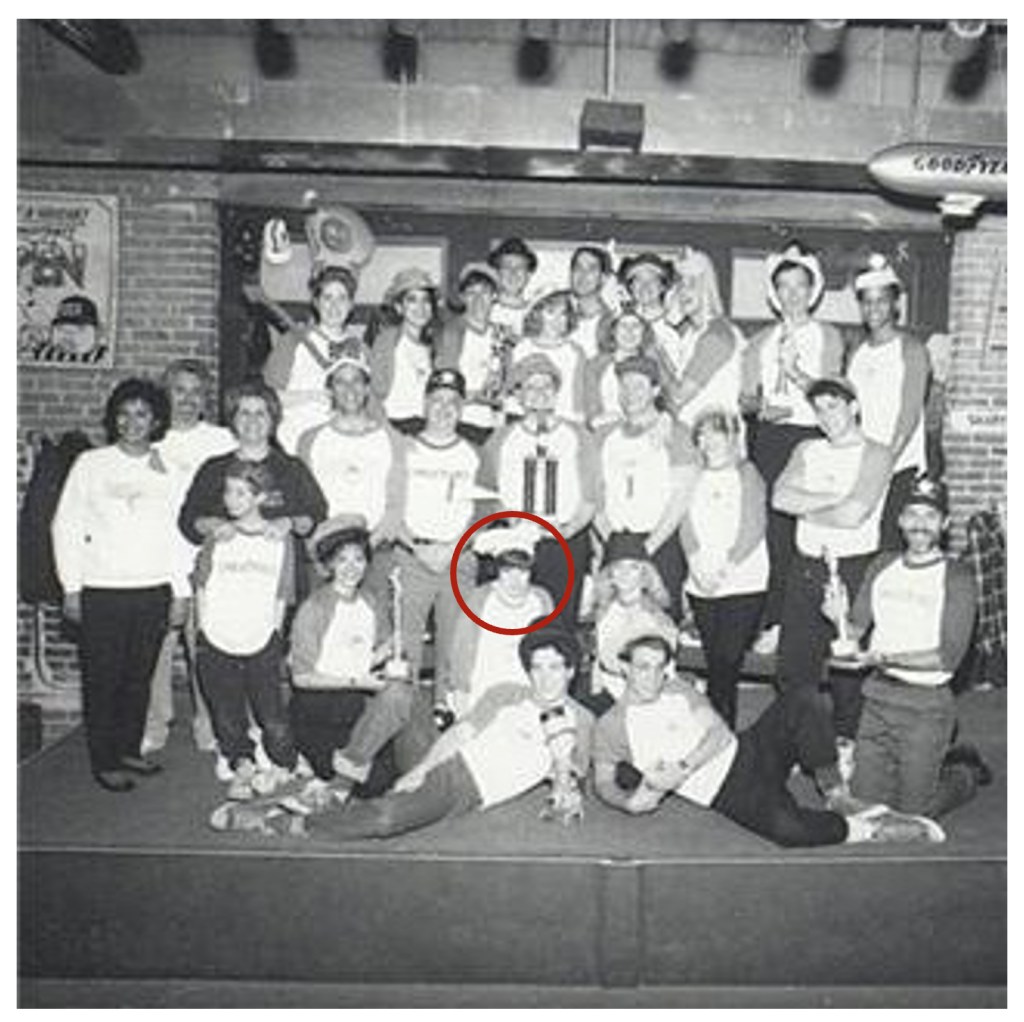
My ex-boyfriend and I started the Lighten Up Improv Co. in 1992. In 1998, we split up, I left, and he immediately closed the Lighten Up Improv Playhouse. In between:
- We vowed to learn from mistakes we’d seen at the other theater.
- We auditioned hundreds of people and brought on dozens of players.
- Most of our romantic relationships were with performers in the group or their friends. Each of us handled that very differently. Neither of us always handled it well.
- We did our best at running things, but could have done much better.
- We at least made different mistakes than the other theater.
I returned to my corporate job but never stopped playing. Improvisers still comprise many of my best friends. It has been more than a quarter of a century since I dated one.
Yes, and…#MeToo
In 2016, the #MeToo movement brought up issues many of us had dealt with for years. (Google “MeToo improv” or “sexual harassment in improv” to start your reading list.)
Women at improv theaters in big cities and smaller communities recounted instances of inappropriate behavior, unwanted advances, and sexual assault. Many women feared retaliation if they spoke up against influential performers, teachers, and directors.
Turns out that reporting incidents feels career-limiting and unsafe when the person handling the complaint also makes casting decisions.
Leadership in improv-centered organizations has historically been slow to implement anti-harassment policies, sometimes dismissing complaints as women “making up stories” for attention—or as just part of the culture.
Then there’s what happens on stage.
Because many improv communities and groups are male-dominated and/or directed by men, the subjects of jokes, content, and comedic styles can be dominated by what men find funny.
When many of the gatekeepers are straight, white men, featured performers may look a lot like them—whether intentionally or not.
The foundational improv rule, “Yes, and,” can be exploited by toxic performers to force women into uncomfortable scenarios. Too often, we find ourselves in scenes that take sexual, subservient, or demeaning turns. It leaves women and non-male improvisers feeling at best out of place or at worst, humiliated.
And again, if we speak up? We’re complainers. Bad sports. Not funny.
Back in my day...
Even “trust building” exercises—the first things we used to do with groups of people who weren’t familiar with each other—were almost always physical challenges. Put on this blindfold—your new cast-mate is going to grab your hand and take you for a walk. Lie down and close your eyes—the whole group is going to lift you above their heads and carry you around. Get up on this ladder and fall into your fellow players arms.
Exercises like these came from books aimed at all ages of players—kids through adults. We didn’t ask permission, talk about boundaries, or make accommodations. The point was to get used to all kinds of physical contact.
Survey says…
I’m a feedback nerd.
My first job was reporting for a small town paper, so getting edited was part of the gig. That continued on my college paper, with input about my performance, too. As advertising majors, we began every class by looking at a bulletin board covered with everyone’s ideas, then we practiced giving and getting notes. At my corporate job, “360° reviews” were a chance to give and get feedback from all around you: employees, partners, and managers.
Improv-land is not a feedback-rich environment. Our community survey was intended to bring important conversations out in the open in a safe way and get information to people who could do something about it.
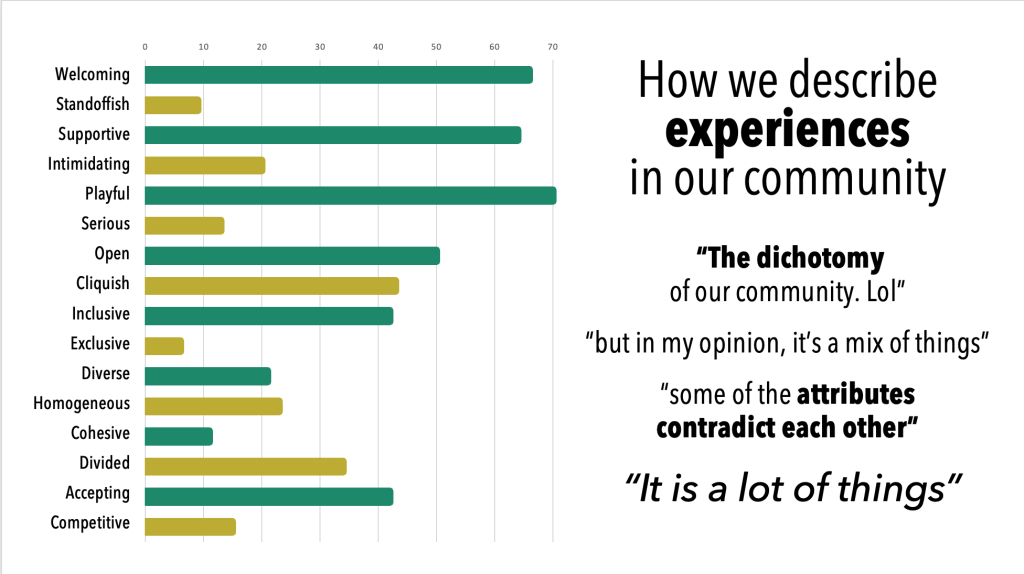
There’s so much good in our community, y’all.
Otherwise, who would stick around? On the positive side, people rated our community as a whole as welcoming, supportive, and playful.
But there’s this question: “Have you ever felt unwelcome or been harassed, mistreated, or abused within the improv community because of your identity?”
The majority (73.9%) answered “No.” But that still means a bunch of people were treated badly because of who they are.
Since the November presentation, I’ve spent more time going through comments and answers to open-ended questions. I isolated the responses from people who self-identified as something other than male, then reviewed all of their comments for mentions of gender bias and gatekeeping, references to discomfort and humiliation on stage, and descriptions of sexual harassment.
Of 93 respondents, almost half of the 42 KC improvisers who self-identified as something other than male mentioned negative experiences ranging from casual sexism to sexual harassment that have occurred in multiple improv groups over 20-something years.
What the survey, the conversations, the personal experiences make crystal clear: The problem is about more than one person or one place. As in many other improv communities, sexism and sexual harassment are part of the KC improv culture.
How it begins
People who run improv theaters usually start as players, peers, and pals. When we become owners or directors, we still join our casts on stage, at post-show bar hangs, and at parties. Boundaries are fluid and blurry. We find ourselves accountable only to the rules we set for ourselves.
Leaders don’t make much money and we don’t have much power except over what players want most: stage time and being part of a community.
Cast members decide to live with leaders’ bad behavior because they just want to play.
They want to be backstage, on-stage, and with their friends at the gatherings. This matters so much that they don’t call out discomfort or abuse, don’t leave until they’re truly miserable, and don’t speak out because…well, because of all the reasons women don’t speak out in these situations.
Quite a few improv companies and countless indie teams in Kansas City have started because players had different ideas about how to run a group.
We almost always try to improve things from the inside first.
We often fantasize about taking over the theater from the owner.
Many players leave quietly.
Some are kicked out or made to feel unwelcome.
Some form new groups and find new stages.
Engineered for safety
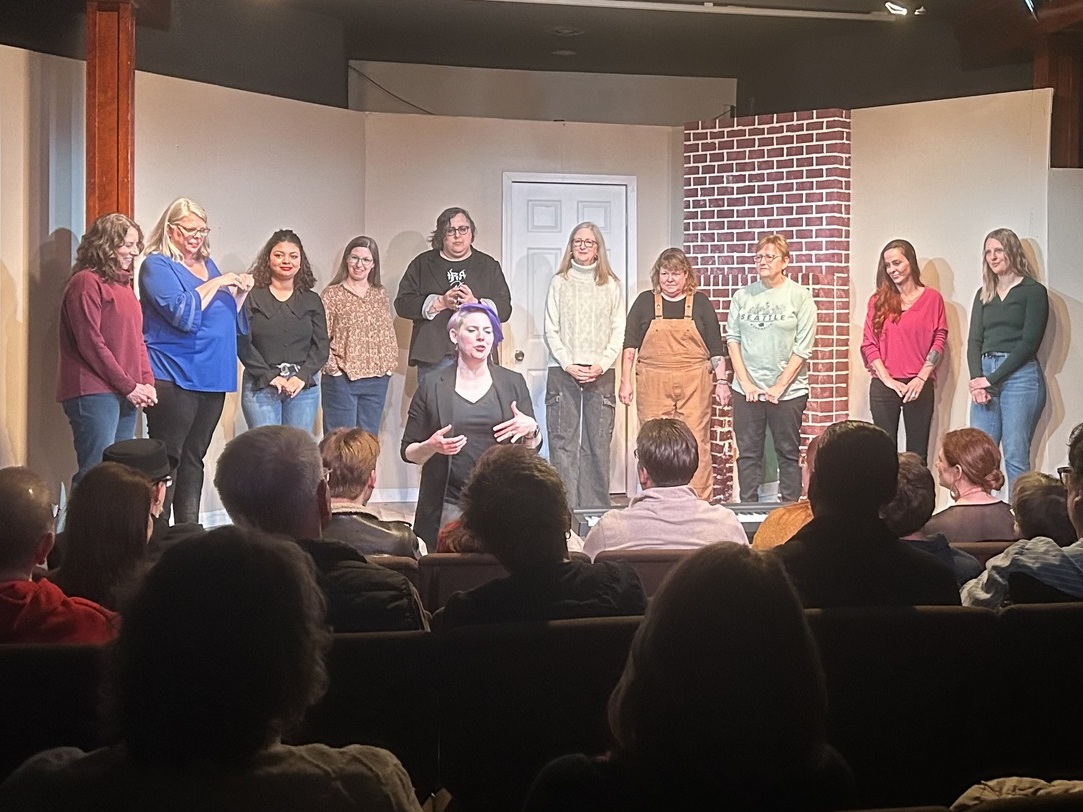
Marian McClellan is an engineer with a whole career in a male-dominated industry behind her. When she started improvising a few years ago, she quickly noticed differences between the ways men and women show up.
She wanted to take more classes from and with women, and that meant producing her own. She learned as she went, first hiring Ham Kitty to direct and perform in a show, then adding classes, jams and workouts, and more shows.
From the beginning, Marian has run Improv Springboard like a start-up. She sets goals and gives herself deadlines. She networks, asking questions and learning from people with different experiences. She has a spreadsheet full of notes about different experiments, venues, and partners. Before and after each event, she asks participants to compete surveys about expectations and results.
She trusts her gut and believes the data. She’s found directors and teachers who share her values and believe in her mission.
In just a few years, Improv Springboard has become that rare space where women and non-binary improvisers can be confident they’ll feel respected, safe, and nurtured.
Rules and tools
To oversimplify: Leaders need rules and players need tools. In Kansas City, we don’t always see the improvements larger cities have put in place to ward off sexual harassment.
Leaders of small and medium-sized improv companies don’t have (or don’t want) the level of infrastructure you find in big improv companies, non-profit theaters, and corporate situations.
- People in charge don’t get feedback from employees, partners, and leaders in 360° reviews or coaching from mentors or managers
- Improv leaders don’t typically sign policies about office conduct, watch videos about what sexual harassment looks like, or suffer consequences when they cross a line.
- Nobody’s talking to them about generational differences and changing expectations in the workplace or the kinds of cultural insights that could be helpful and relevant.
Players—performers and students—don’t have anyone to turn to or agreed-on policies to rely on when leaders do harm.
Consequences for others’ behavior falls on the people—often women—who have been harmed. They get the blame when someone in charge is ousted or a group shuts down.
Other communities have figured out solutions faster than we have:
- Our neighbors at the KC Theatre Safety Initiative formed “to provide public standards in a community agreement, uniting theater artists and companies in an effort to build a safer and more transparent future.” Their Community Agreement isn’t a legal document: It’s a living document that provides a set of standards and best practices for the production of safe, effective, and well-considered theatre.
- Fair Play MN, a collective of women-trans-femme-nonbinary improvisers in the Twin Cities, has created a conversation guide for boundaries conversations and posters explaining different levels of intimacy (touch and content) for scenes
- HUGE THEATER, Pam Victor, and The Improv Teachers’ Support & Collaboration Facebook Group created a Bill of Rights for improvisers that is in use by multiple groups.
Which brings us, finally, to this:
3 things every KC improv group can do right now to make us feel safer from sexual harassment
Based on recommendations from the KC improv survey, policies in other cities, and habits some of us are already forming, here are three things every group can start doing immediately.
- Start every rehearsal, warm-up, workshop, and class with boundary conversations or check-ins. Acknowledge that players have the right to change their boundaries without apology or explanation based on who they’re playing with, who’s in the audience, current events, or how they’re doing that day.
Improv Springboard does it. I do it when I coach and teach. Explosive Group Chat just started doing it, and we’ve found that the more comfortable we get around each other, the more checking in matters. - Put plans in place for addressing improvisers’ discomfort and any boundary violations in the moment. This includes in classrooms, backstage, and on-stage. Make it easy to call a situationally appropriate time out. Don’t put all the pressure on the person who’s uncomfortable to stop the scene.
- If you’re a leader, teacher, director, or coach, understand that you do not have a peer-to-peer relationship with players. Keep your hands to yourself. Don’t flirt with or hit on the cast or students. Be self-aware enough to take yourself out of casting decisions if a relationship causes you to be unduly biased. Approach dating other improvisers with caution, especially if you have any influence over their stage time.
That’s just a beginning.
Putting an improviser bill of rights in place or signing the KC Theatre Safety Initiative’s Community Agreement will mean putting infrastructure in place—a little bit for a troupe or company, much more for a community or collective.
And there are lots of questions for us to answer:
Who do you report things to if you’re not comfortable talking to the owner, director, coach, or teacher? What happens next? How do you move on?
How do we make things better from the inside—and what do we do when that doesn’t work?
Where can we go to learn new behaviors and talk about our challenges in constructive ways?
What do leaders who’ve made mistakes in the past do with new information, expectations, and changes in the culture?
What are the most helpful ways for us to respond to being called out on harmful behavior?
To paraphrase Tara DeFrancisco and The Improv Retreat: How will we leave people better than we found them?
What are your thoughts?
(If you choose to comment here, please follow the forum rules above: No personal complaints and speak from your own experiences.)
 TRISH BERRONG
Leave a comment