
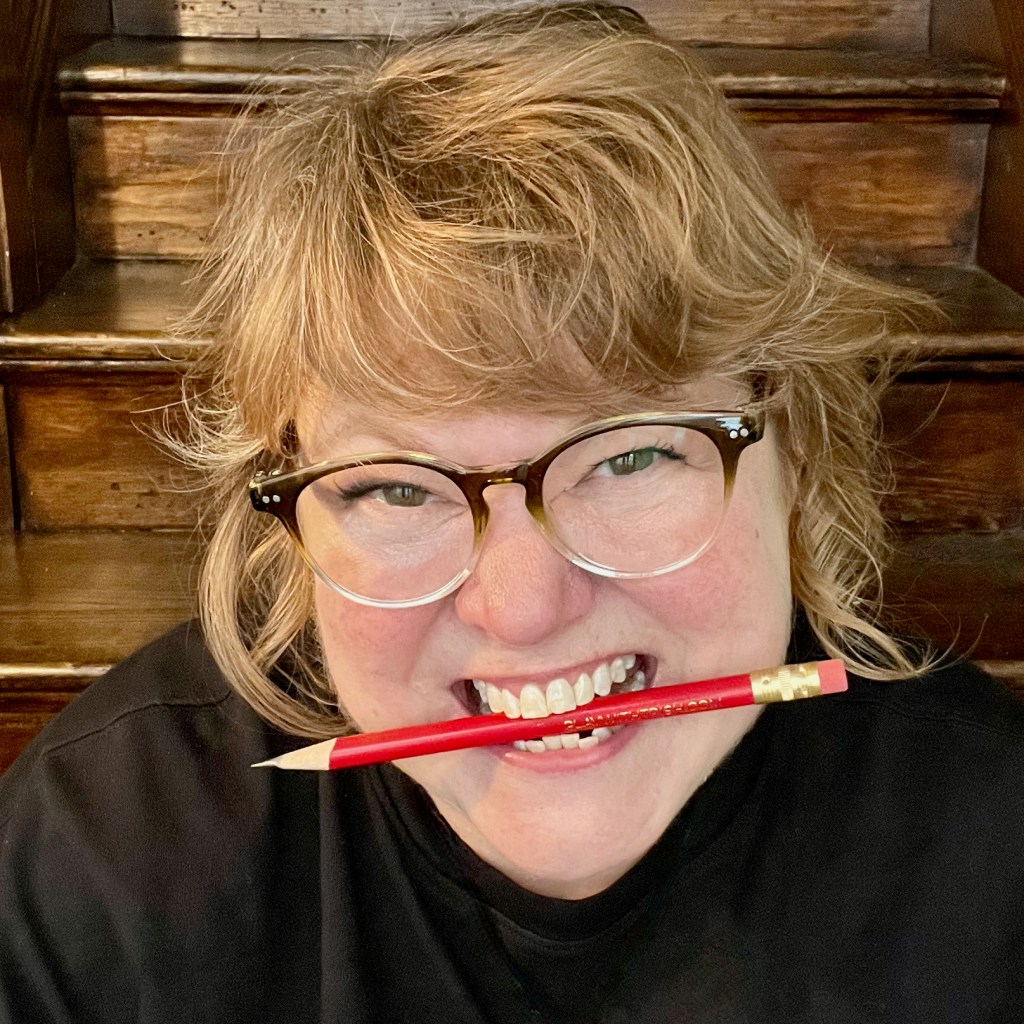
I’ve got a thing for big red pencils. If you’ve met me, been to one of my classes, or seen me play, I’ve probably shoved one at you.
So when Michelle Plante invited me to read in a storytelling event for “people reading short letters they were never meant to share,” it seemed like a good chance to say why.
Here’s my letter:
To the faculty and staff of Gaines Elementary School in Athens, Georgia:
You won’t remember me, and that’s OK.
I was in Mrs. Jackson’s First Grade home room at the beginning of the school year in 1972.
I was the one who lost a lot of big red pencils.
It seems like a weird thing to remember, except that I apparently pushed Mrs. Jackson right over the edge one day when I couldn’t find my big red pencil in my desk.
In my defense, my “desk” was a spot at a long table with a cubby hole for all my papers and crayons and Kleenex and cool rocks I found on the playground. Now I know that my organization style is all about being able to see things or I forget they exist. So it’s entirely possible my big red pencil was actually somewhere in that stupid cubby hole.
But I think we were having a test that day and I couldn’t find it and so I had to slink up to Mrs. Jackson’s desk all sweaty and panicky.
Also. If not in the cubby, exactly where was I supposed to keep the big red pencil? Back then, pockets on little girls’ outfits were decorative—if we had them at all. And we had to change classes. Like, every couple of hours. In all that going up and down the halls to music and math and art and science, I was supposed to just…what, carry the pencil in my hand?
What if we stopped at the water fountain? Or had a potty break?
As I cowered there at her desk, Mrs. Jackson looked up at me and sighed
in a way that said she wasn’t angry…she was just disappointed.
She took out a brand-new box of big red pencils and announced to the class that I’d lost mine—again—and that it wasn’t fair to just give me one.
Everyone was going to get a new pencil and—she looked me dead in the eyes when she said this—we should all take better care of our things.
(By the way, I’m not mad at Mrs. Jackson. She was smart and cool
and seriously seemed like she had her act together.)
The point of this letter: I realize it’s way too late, but I wanted to say thank you to my reading teacher, Mrs. Flint.

I was good at reading (I still am) so she was already my favorite. Her classroom was the one across the hall, with a table in the back for reading lessons. Her room had rows of desks with room for storage underneath that you could see into from both sides. And there was a space on top made specifically to hold a pencil. Also, there was a poster of a really cute puppy next to her chalkboard.
I’m not sure how long it was before I lost that big red pencil Mrs. Jackson gave me, but I realized it as I was leaving Mrs. Flint’s class.
I got sweaty all over again and my stomach twisted with shame and I was already trying to figure out what I was going to say to Mrs. Jackson when I got back to home room. Mrs. Flint must have noticed because she asked me what was wrong and I told her and she probably put her hand on my shoulder and said it was going to be OK.
Then she took me over to the bookcase that separated the reading table
from the rest of the class, and on the bottom shelf there was a wire basket full of all the big red pencils kids had lost: new pencils, stubby pencils, chewed-up pencils, pencils that barely had erasers left.
Mrs. Flint told me to take one. And she said if I ever found myself without a pencil again to tell Mrs. Jackson I needed a bathroom pass, then come over to her classroom. She said I didn’t have to knock, and she wouldn’t call attention to me when I snuck in to pick out another big red pencil.
Now I know that I have ADHD. I found that out when I was 58. But as a little girl growing up in the 1970s, all I knew was that I was thoughtless and irresponsible and talked too much in class.
Mrs. Flint must have seen a bunch of kids like me—little overachievers fighting their wandering imaginations and trying so hard to be like everyone else.
She was patient and kind with everybody, even when they didn’t always
act like they were supposed to. She understood that “fairness” might mean different things to different kids.
Mrs. Flint was my reading teacher, but now I know the most important things she taught me are called “empathy” and “equity.”
I only attended Gaines Elementary School for a few months in the 1970s.
But my time there—along with hours of watching Sesame Street and
Mister Rogers’ Neighborhood—helped shape what I believe about
how we should treat people and what it really means to be fair.
I just needed to tell you that.
Sincerely,
Trish Berrong
P. S. In honor of Mrs. Flint, I bought a whole bunch of big red pencils. I’ll always have one handy for anyone who needs one.

 TRISH BERRONG
Leave a comment